Family Owned. Midwest Values. National Reach                                                                                              Call Now: 877-247-1975 GET A QUOTE

Latest Blog

Why Summer Is the Perfect Time for Sealcoating in Chicago
Latest Blog

Why Summer Is the Perfect Time for Sealcoating in Chicago

Why Summer Is the Perfect Time for Sealcoating in Chicago

Sealcoating is a protective barrier that can help asphalt pavements in Chicagoland shrug off cold winters, UV rays, automotive fluids, and other potential threats. However, sealcoating can be a bit tricky to apply because they are so sensitive to the weather conditions during and immediately after they are applied. The summer months typically offer the best combination of weather conditions, making it a great season for Chicago sealcoating.

What Are the Weather-Related Factors That Affect a Sealcoating Application?

There are four factors that every Chicago sealcoating company must consider when deciding whether conditions are suitable for an application.

1. The surface and ambient temperatures must be within the tolerance range specified by the asphalt sealcoating manufacturer.
2. The relative humidity levels must also be within the specified range.
3. When sealcoating Chicago pavements, contractors must ensure that the fresh sealcoat will receive sufficient sunshine.
4. The weather forecast should not predict rain on the day of or the day after the application.

Why Summer Is the Perfect Time for Sealcoating in Chicago

What Are the Acceptable Temperatures for Sealcoating Parking Lots and Other Asphalt Pavements?

An asphalt sealcoating company is concerned about both the ambient and surface temperatures. Normally, these two temperatures are quite close, but there can also be significant differences. For example, after a cold night, the surface temperature may be several degrees cooler than the ambient temperature. Manufacturers usually instruct their customers to only apply if both the surface and ambient temperature is above 50 degrees when the application commences. Furthermore, the temperatures should continue to rise throughout the day, and they should not fall significantly for the following 24 hours.

What Effect Does the Relative Humidity Have on Sealcoating?

Sealcoat cures by evaporating the water contained in the mix. Excessive humidity slows evaporation, so the sealcoat will take longer to cure, potentially requiring you to keep your pavement closed longer. During a typical year, the average relative humidity in Chicago is at its lowest during May, June, and July, and August usually has comparatively low humidity levels.

Why Does Sunshine Matter to a Sealcoating Contractor?

The first reason is that sealcoating needs at least three or four hours of sunlight to cure properly. The second reason is that an asphalt sealcoating company can accomplish more on long summer days. For example, when sealcoating parking lots, the standard calls for two coats of sealcoat, followed by parking lot striping. The first coat of sealant must dry before the second can be applied, and the second coat must dry before the stripes and pavement markings can be applied. Depending on the size and complexity of the parking lot, it is often possible for a sealcoating contractor to complete all the work in one day, which makes things more convenient for you as well as your contractor.

Why Does an Asphalt Sealcoating Company Worry About the Forecast of Rain?

Just like asphalt paving contractors, an experienced sealcoating contractor knows that rain can affect the aesthetics of the pavement’s surface. Furthermore, if the sealcoat is in the early stages of curing, a heavy rain can wash it away.

Why Should I Call Black Hawk Paving for Assistance?

First of all, we are highly experienced Chicago paving contractor, having been founded in 1975. Secondly, we have an exemplary reputation for professionalism, craftsmanship, integrity, and customer service. Furthermore, we have the ability to successfully complete jobs of all sizes for national clients as well as local businesses. In addition, we offer an extensive range of services, including asphalt sealcoating, asphalt paving, asphalt crack repair, asphalt milling, parking lot striping, pavement markings, excavations, sewer repairs, traffic sign installation, site grading, and car stops, and we also install concrete curbing and flatwork. Contact us today to request a free quote; simply fill out the form and submit it online, email Info@BlackHawkPaving.com, or call us at 708-478-0400, 773-378-2390, or 847-240-2560.

Asphalt Overlay or Asphalt Replacement?
Latest Blog

Asphalt Overlay or Asphalt Replacement?

Asphalt Overlay or Asphalt Replacement?

Although asphalt pavements are quite long-lasting when given the proper attention, every pavement will eventually need more than just a few repairs. When the time comes, you might think that you have no choice except to replace your pavement. That might be the case, but it is also possible that an asphalt overlay is a faster, more economical solution.

What Is an Asphalt Overlay?

An overlay is often referred to as asphalt resurfacing. Normally, contractors remove about three inches of the existing pavement with an asphalt milling machine, send the milled particles to an asphalt recycling plant, then install new asphalt paving to replace what they removed.

What Is an Asphalt Pavement Replacement?

A replacement means that the contractor will remove all layers of the asphalt and, in some cases, the base layers. If necessary, the base and subbase are repaired, rebuilt, or strengthened, and new asphalt is then installed to reconstruct the pavement.
Asphalt Overlay or Asphalt Replacement?

What Factors Determine Whether Overlaying Pavement Is Better Than Replacing It?

Basically, the decision boils down to an issue of which method is more cost-effective. If the base does not have extensive damage, an overlay is typically more cost-effective. However, if the base has been compromised underneath more than about a third of the pavement, a replacement may be more cost-effective. The same is true if more than about a third of the pavement has severe damage that goes deeper than what the paving contractor plans to remove for the overlay. Another factor that can determine whether asphalt resurfacing is the better option is the presence of subterranean issues that can only be corrected by removing or accessing the base layers.

Are Overlays Acceptable for Municipality Paving Projects?

Many municipality paving projects involve overlaying streets, parking lots, and other public pavements. When paving Chicago thoroughfares and parking facilities, the same factors would apply for determine the cost-effectiveness of an overlay as a parking lot paving company would evaluate for overlaying a privately owned pavement.

Is an Asphalt Overlay Possible for a Concrete Pavement?

In some cases, overlaying a concrete pavement is both possible and effective. In fact, there are many stretches of concrete pavements on interstate highways that have had overlays installed. However, it is possible for underlying patterns, including expansion joints, to eventually show up in the overlay. This is also the reason that a parking lot paving company should repair cracks and other damage before placing an overlay.

In Terms of Appearance, What Is the Difference Between Overlaying Pavement and Replacing Pavement?

In most cases, the appearance of an overlay will be virtually indistinguishable from a new asphalt pavement. However, unless asphalt milling is performed, the elevations of manhole covers, grates, curbs, and transitions will not be retained, and this can make it obvious that the pavement has received an overlay.

Do Overlays Require Any Maintenance?

Overlays should receive the same maintenance as a new asphalt pavement. At the very least, you should keep the overlay clean, promptly repair any cracks that develop, and have your contractor sealcoat it periodically.

Since 1975, Black Hawk Paving Has Served the Greater Chicagoland Area

If you are trying to decide between replacing your pavement or overlaying it, we can help. Black Hawk Paving is a leading paving and construction company with an impeccable reputation for workmanship, service, and integrity. We offer numerous services, including asphalt resurfacing, sealcoating, asphalt paving, parking lot striping, asphalt milling, excavations and grading, asphalt fabric, concrete paving, pavement markings, traffic signage, sewer repairs, car stops, and asphalt crack repair. To request a free quote, you can call 708-479-0400, fill out our contact form, or email Info@BlackHawkPaving.com.

5 Sealcoating Facts That Show Savings for Your Chicago Pavement!
Latest Blog

Five Sealcoating Facts That Show Savings for Your Chicago Pavement

Five Sealcoating Facts That Show Savings for Your Chicago Pavement

Asphalt paving is a logical choice for virtually any pavement in the Chicago metropolitan area. Asphalt pavements can be installed quickly, and they are more economical than comparable concrete pavements. Furthermore, a well-engineered, properly constructed, and well-maintained asphalt pavement can cope with the brutal winters for which Chicago is famous. However, if you want to obtain the best return on your asphalt investment, you should consider sealcoating your pavement periodically.

What Is Sealcoating?

A seal coating mix is a combination of water, sand, and a powdered sealcoat concentrate. Chicago sealcoating contractors often recommend incorporating an additive to accelerate drying, keep the sand evenly suspended, or enhance certain sealant properties. An asphalt sealcoating company will normally apply two thin coats of sealant, allowing the first to dry before starting the second. When sealcoating parking lots, it may be necessary to apply a third coat in the areas that receive the most traffic.

What Are Five Facts Which Demonstrate That Sealcoating Can Help Me Save Money?

1. Seal coating is economical, but it is a highly effective way to reduce repair bills and prolong the life of your asphalt pavement.
2. By blocking UV rays and resisting automotive fluids, parking lot sealcoating can help prevent the pavement from becoming brittle or crumbly.
3. A professionally applied, high-quality parking lot sealcoat increases the chances that your pavement’s foundation will be strong enough to allow an asphalt paving company to resurface the pavement instead of rebuilding it.
4. Sealcoating parking lots makes them safer by enhancing traction.
5. Seal coating increases the speed at which snow and ice will melt, improving safety and allowing you to reduce or eliminate the use of harsh deicing agents.

5 Sealcoating Facts That Show Savings for Your Chicago Pavement!

How Often Do Chicago Sealcoating Contractors Recommend Sealing an Asphalt Pavement?

It is impossible to recommend a precise schedule without knowing more about your particular pavement. How old is it? What is its condition? Does your pavement support passenger vehicles, pedestrians, or heavy trucks? How many vehicles drive or park there on an average day? As a ballpark estimate, Chicago sealcoating typically lasts between 18 and 30 months. Your initial application should not be performed until the asphalt has cured, but it should not be postponed for more than 10 or 12 months from the time your asphalt paving company installed your pavement or overlay.

What Else Should I Know About This Service?

There are two things you should keep in mind before you schedule an appointment with a sealcoating company.

1. You want to stick to the schedule recommended by your contractor. If you delay too long, your pavement will not have the protection it needs. However, some property managers err on the side of caution and sealcoat their pavements annually. This is almost always a waste of money; the sealant will probably crack and flake off, or it will remain a gooey mess that gets tracked everywhere.
2. Sealcoating obscures painted stripes and pavement markings, so you will need to have your contractor repaint them after applying your parking lot sealcoating. Repainting can begin as soon as the final coat of sealant has dried sufficiently, so your contractor may be able to perform both tasks on the same or consecutive days.

Whether your property is part of a national chain, a locally owned store, or a different type of commercial enterprise, we can assist you. Black Hawk Paving offers an extensive range of paving services, including asphalt milling and grinding, seal coating, asphalt repair, parking lot striping, hot crack sealing, concrete curbing, site grading, car stops, excavations, asphalt paving, asphalt resurfacing, sewer repair, traffic signage, and asphalt fabric. We are a highly respected company with an exemplary reputation for service, craftsmanship, and dependability. We offer free quotes, so contact us to request yours today. You can submit our online form, email Info@BlackHawkPaving.com, or call 708-479-0400, 847-240-2560, or 773-378-2390.

How Is Sealcoating Different From Asphalt Paving?
Latest Blog

How Is Sealcoating Different From Asphalt Paving?

How Is Sealcoating Different From Asphalt Paving?

Unless you have worked in the asphalt industry, you probably find some of the terms used by paving companies to be somewhat confusing. For example, if you need a pothole repaired, you might not understand the differences between a throw-and-go and a throw-and-roll repair, or you might wonder what the difference is between a full-depth and a partial-depth patch. Similarly, not every property owner is aware of the differences between sealcoating and asphalt paving.

What Is the Main Difference Between Paving and Sealcoating?

Perhaps the simplest way to explain the primary difference between asphalt paving and seal coating is to imagine that you are installing a genuine hardwood floor in your home. The strips or planks are installed, and you could conceivably end the process at that point, but you would be leaving your floor vulnerable to damage. Therefore, you apply varnish or other sealant to protect the wood. The asphalt paving Chicago contractors install is roughly equivalent to your wood floor, and the seal coat your asphalt maintenance contractor applies is roughly equivalent to the varnish on your floor.

What Are Some Other Differences Between Asphalt Paving and Seal Coating?

One important difference is the cost associated with each of the two procedures. Paving contractors will charge substantially more to build, reconstruct, or overlay a pavement than sealcoating will cost. Because material costs can change frequently, it is impossible to provide a precise comparison. However, as an example, parking lot paving typically costs at least seven times as much as parking lot sealcoating, and the difference can be as much as 12 to 15 times as much. Another important difference is how businesses and organizations account for the costs. Although there is no universal standard, a seal coat application is usually considered a maintenance expense. A new pavement is typically considered a capital asset. Depending on the circumstances and the organization’s policies, an overlay could be expensed as a repair or capitalized as a fixed asset. Yet another critical difference is the expected life of the two procedures. With proper care, an asphalt company will normally expect an average parking lot in Chicagoland to last 12 to 15 years before it needs an overlay or a reconstruction. Parking lot sealcoating seldom lasts more than two years before a fresh application is required.

How Is Sealcoating Different From Asphalt Paving?

How Quickly Does a New Asphalt Pavement or Overlay Need an Application of Sealcoat?

Asphalt paving contractors usually do not recommend sealing a new pavement until it has cured sufficiently to exhaust any excess oils. Depending on the time of year and other factors, this could take as little as two or three months, or it could take eight or nine months. The longest you should wait to seal new asphalt is 12 months. You will need to ask your asphalt paving company for a more precise timeline. While you are waiting, remember that your pavement is vulnerable, so give it a little extra attention. Remove spilled fuel, oil, and other vehicle fluids promptly. Avoid placing heavy loads on the pavement and leaving them stationary for more than a day or two. Remove dead vegetation, trash, dirt, and other debris promptly.

For Superb Paving Services, Contact Black Hawk Paving

From local retailers with a single store to national banking chains, our clients know that they can count on us to help them optimize their pavement investments. Black Hawk Paving offers a full range of paving services, including asphalt paving, parking lot sealcoating, asphalt milling and overlaying, concrete flatwork, excavations, parking lot striping, car stops, and site grading. We are a family business that was founded in 1975, and we remain committed to building strong relationships through exemplary craftsmanship and remarkable service. We would be happy to provide you with a free quote. You can fill out the online form, email Info@BlackHawkPaving.com, or call either 708-479-0400 or 847-240-2560.

What Are the ADA Compliance Guidelines?
Latest Blog

What Are the ADA Compliance Guidelines?

What Are the ADA Compliance Guidelines?

Regardless of the type of commercial property you own or manage, you must handle a myriad of tasks every day. One of the most challenging tasks is often ensuring that your parking lot meets all guidelines, codes, and laws for accessibility and safety. Without a doubt, one critical set of guidelines you must meet relates to the Americans with Disabilities Act, the federal law related to achieving and maintaining ADA compliance.

What Is ADA Compliance?

The ADA addresses many different features that may or may not apply to your property, but one extensive section on parking lots applies to virtually every company or organization that serves the public. Very few properties are exempt from the statutes covering ADA compliance for parking lots. ADA guidelines specify how many accessible spaces you need, where they must be located, how they must be identified, and how large each space must be. The guidelines also cover the slope of the spaces, accessible routes, and ramps, and they address the issue of obstacles in spaces and routes. There are numerous other requirements contained in the ADA guidelines, so the best way to avoid parking lot violations is to ensure that your asphalt paving company or maintenance contractor has extensive experience and full knowledge of all applicable regulations. It is important to remember that state and local regulations can sometimes exceed the ADA requirements. For example, to be ADA compliant in Illinois, you must also meet the requirements contained in the Illinois Environmental Barriers Act.

What Are the ADA Compliance Guidelines?

Who Must Comply With the ADA?

The ADA requires all government agencies, private companies, and charitable or nonprofit organizations that serve the public or employ at least 15 employees to comply. Illinois defines the public as either employees or users of the building. Houses of worship, private clubs, and religious organizations and the facilities they control are typically exempted from the ADA guidelines.

Why Is ADA Compliance Important?

All provisions are important, but ADA compliance for parking lots is especially critical.

1. Your parking lot is typically the first thing that people driving by or entering your property see. If your lot is not compliant, you could be perceived as not caring about your customers or tenants with mobility issues.
2. Parking lot violations in the Chicago area can result in substantial fines or penalties, or you could find yourself sitting at the defendant’s table in a lawsuit. Fines can be as much as $150,000, and business owners could also be investigated by the Illinois Attorney General’s Disability Rights Bureau.
3. You could be losing sales if potential customers with disabilities cannot safely park in your lot or access your building.

If you need help to achieve or maintain ADA compliance, contact Black Hawk Paving and Construction. We offer a full range of services, including parking lot striping, asphalt paving, concrete flatwork, asphalt repair, car stops, asphalt crack sealing, site grading, and asphalt sealcoating. We serve local clients as well as national chains. We are known for delivering exceptional quality and exemplary customer service at competitive rates. For a free quote, submit the online request form, call 708-479-0400, or email Info@BlackHawkPaving.com.

Sealcoating: The Common Failures and Causes
Latest Blog

Sealcoating: The Common Failures and Causes

Sealcoating: The Common Failures and Causes

If you want your asphalt pavement to have its longest, healthiest life, you should make sealcoating an essential part of your maintenance program. A sealcoat can help prevent damage from automotive fluids that can soften your pavement, and it is extremely effective at blocking the UV rays that can make asphalt pavements brittle, dry, and faded. Naturally, you want your sealant to last as long as it should, but failures can happen. Common failures include insufficient bonding, cracking, flaking, and peeling, but these failures have many potential causes. Common causes include inadequate pavement preparation, application errors, timing mistakes, and weather issues.

In the Sealcoating Industry, What Does Inadequate Pavement Preparation Mean?

Every pavement needs to be properly prepared to accept the sealant, and any of the common types of failures could be the result of overlooking preparation. Pavement preparation includes all of the items on the list below.

  • Whether they are sealcoating parking lots, streets, or walkways, contractors must clean the pavement thoroughly. Any contaminant on the pavement, including tree sap, dirt, and gravel, can interfere with the bond between the sealant and the pavement.
  • Asphalt sealcoating contractors often need to prime certain problem areas to ensure proper bonding. Problem areas may include oil stains, areas experiencing aggregate polishing, and patches with extreme oxidation.
  • Cracks and other pavement breaks must be repaired prior to sealing. Sealants are not repair products. If there are breaks, the sealant will flow into the void and be wasted.

How Might Application Errors Cause Sealcoating to Crack?

One common mistake that some asphalt maintenance contractors make is to apply a coat of sealant that is too thick to cure properly. To maximize protection, sealants should be applied as two thin coats, and trying to apply the same amount in one coat is a recipe for failure. Another common application error occurs when asphalt sealcoating contractors prepare the sealant mix incorrectly. Parking lot maintenance companies receive powdered sealant from the manufacturer, and they must add the correct amount of silica sand and water to create a liquid for application.

When Sealcoating Parking Lots or Other Asphalt Pavements, How Might Timing Issues Lead to Failure?

The first timing issue happens when people sealcoat a new pavement before it has time to lose the excess oil that the asphalt contains. Your asphalt contractor should tell you how long to wait, and this could range from 90 days to 11 months. The second timing issue is to have a sealant applied too often. Chicago sealcoating has an average life of approximately two years on most pavements. However, some pavements can go three or four years between sealant applications.
Sealcoating: The Common Failures and Causes

How Do Weather Issues Affect the Quality of a Parking Lot Application?

  • Sealants are highly reliant on the weather for evaporating the water they contain, and proper evaporation is crucial for proper curing.
  • Sealants should never be applied to a wet pavement, and no precipitation can occur for at least the first 24 hours of the sealant’s life.
  • If the wind speed is high, the top layer of the sealant could dry long before the lower levels, especially if the pavement is hot and humidity is low. The trapped sealant can continue to flow, cracking the top layer.
  • Sealants cannot be subjected to freezing temperatures until they are completely cured. Asphalt sealcoating contractors must make sure that the forecast does not predict temperatures below or near freezing around the time of the application.

If you have additional questions about asphalt sealing, let the experts at Black Hawk Paving provide you with the answers. We have been serving the greater Chicago area with exceptional work since 1975. Our services include asphalt sealcoating, parking lot striping, asphalt paving, concrete flatwork, asphalt milling, hot crack sealing, asphalt repairs, site grading, car stops, sewer repair, parking lot signs, asphalt fabric, asphalt overlays, excavations, and concrete repairs. We serve a wide range of clients, including national chains, hospitals, car dealerships, and shopping centers. We are known for our honesty, craftsmanship, and customer service, but our rates are extremely competitive. We offer free quotes, so contact us today to submit your request. You can fill out the online form, email Info@BlackHawkPaving.com, or call either 708-479-0400 or 773-378-2390.

What Is the Process for Asphalt Paving Construction?
Latest Blog

What Is the Process for Asphalt Paving Construction?

What Is the Process for Asphalt Paving Construction?

To the uninitiated, it may seem that asphalt paving projects only require dumping a load of asphalt and then compacting it. In reality, the construction of an asphalt pavement requires considerably more work. Before the first car drives onto the pavement, your contractor must plan, prepare, and install all the necessary components for your project.

How Do Contractors Plan a Paving Project?

Asphalt companies and paving projects vary, so there is no single approach to planning that works for every contractor or every project. However, a typical asphalt paving company will handle the following tasks during the planning stages.

  • Design the pavement by considering the loads it will support, the terrain surrounding the site, and the soil that will lie beneath the new construction.
  • Calculate the amount of hot mix asphalt and other materials that will be needed for the project.
  • Determine the types and numbers of machines, workers, tools, and supplies that will be needed.
  • Evaluate what will need to be done to ensure a safe working environment, including traffic control measures.
  • Prepare a schedule to ensure that the equipment and specialists will be available throughout the job.
  • Schedule the delivery of truckloads of HMA from the asphalt company.
  • Secure any necessary permits if they are the responsibility of the paving company.

How Do Contractors Prepare for an Asphalt Paving Project?

Whether you hire a road or parking lot paving contractor, there are tasks that must be completed before the actual construction can begin.

  • On some jobs, a paving contractor will need to construct an access road to get the necessary heavy equipment from the nearest public thoroughfare to the exact location.
  • The site will need to be cleared. Depending on the condition of the site, clearing could involve the demolition of an existing pavement, the removal of trees and other vegetation, the razing of existing structures, or the removal of fences or walls.
  • The paving contractor will grade the site to establish the correct slope so that the pavement will drain efficiently. Typically, heavy equipment will be used to handle the bulk of the grading, but smoothing and leveling may be performed manually on some projects.

What Is the Process for Asphalt Paving Construction?

What Does an Asphalt Paving Company Consider the Installation Process?

Companies that provide asphalt paving services typically count the subgrade, base, and pavement itself as comprising the installation process.

  • The subgrade is the ground on which the pavement will rest, so it must be well-compacted before the installation can continue. If the soil is unstable or otherwise insufficient, the contractor may remove some of it so that it can be replaced with more suitable soil.
  • Although some asphalt pavements can be constructed directly on top of the subgrade, it is more common for asphalt companies to install a base. Depending on the project, the base will consist of crushed stone, gravel, or a similar aggregate.
  • After completing the base, or compacting the subgrade if no base was required, the contractor can begin the actual installation work. The first layer will be installed on top of the base or subgrade, then the asphalt will be compacted. Layer by layer, asphalt will be installed and compacted to build the pavement. The final course of asphalt will be the surface layer or driving course.
  • The contractor may perform other steps, including a final roll, before inspecting the pavement with the client.

If you need a dependable Chicago paving contractor with the experience, tools, and staffing to provide you with concrete or asphalt paving services, you can count on Black Hawk Paving and Construction. We offer a full range of services, including asphalt paving, asphalt sealcoating, asphalt milling, concrete repairs, site grading, parking lot striping, asphalt repair, car stops, excavations, hot crack sealing, sewer repair, traffic signage, and asphalt fabric. We serve national chains as well as local clients. Our reputation is immaculate, and our references are impeccable. For a free quote, send an email to Info@BlackHawkPaving.com, call 708-479-0400, or submit the online form.

What Property Managers Need to Know About Asphalt Paving
Latest Blog

What Property Managers Need to Know About Asphalt Paving

What Property Managers Need to Know About Asphalt Paving

It is common for Chicago paving contractors to receive calls from property managers who are trying to decide between asphalt and concrete paving. There are many differences between the two paving materials, and concrete is a better choice for certain uses. However, given the brutal winters that are typical in Chicagoland, asphalt is superior for most pavements, including parking lots. When correctly installed and maintained, asphalt pavements can flex with seasonal temperature fluctuations, and it tends to shed snow and ice faster than concrete. Furthermore, an asphalt pavement will cost less than a comparable concrete one, and you can usually have a new asphalt pavement open for traffic in less time. Nevertheless, there are a few things you should know about asphalt paving, including the best practices for routine care, repairs, and preventive maintenance.

What Should I Know About the Routine Care of Asphalt Paving?

Commercial paving typically endures quite a beating, and Chicago asphalt paving is no exception. It must endure snow, ice, and rain, and it must also endure hot, humid, summers. Snowplows and deicing chemicals can inadvertently inflict damage in the winter, and overheated tires can mar the pavement’s appearance in the summer. Customers can throw their trash in restaurant or retail parking lots, tenants can leave trailers stationary for months at a time, or hotel guests can park vehicles that leave behind deposits of gasoline, power steering fluid, diesel, brake fluid, or other petrochemicals. Most providers of Chicago asphalt paving services stress the importance of keeping pavements clean through routine sweepings and the removal of leaked automotive fluids. Stationary loads should not be left in the same position for more than a week, and snowplow operators should be experienced professionals. Line striping and pavement markings should be kept clean, visible, and free from damage, and those that fail to meet these three standards should be repainted.

What Should I Know About Repairing Asphalt Paving?

Some people think that they can save money by skipping pavement repairs, but the opposite is true. Damage will only worsen over time, and your pavement’s structural integrity can be so seriously compromised that you will be facing extensive major repairs, rebuilding your pavement many years earlier than expected, or both. Although a new pavement may not require any repairs for several years, you should develop the habit of conducting inspections every six months so that you can address problems as soon as they appear. Cracks and potholes should be repaired as rapidly as possible, and drainage issues should be quickly addressed. You should also budget for pavement resurfacing, which is also known as an asphalt pavement overlay, every 10 to 15 years. You will need to ask a reputable parking lot paving company to recommend a schedule that reflects the volume and type of traffic using your pavement. However, not all companies include pavement resurfacing among their normal Chicago asphalt paving services, so make sure that you select a commercial paving contractor with extensive experience and the proper equipment.

What Property Managers Need to Know About Asphalt Paving

What Should I Know About Preventive Maintenance for Chicago Asphalt Paving?

Proactive maintenance can add many years to the useful life of an asphalt pavement. Whether it is a new pavement or an asphalt pavement overlay, preventive maintenance should begin within the first few months and continue for the life of the pavement. Preventive maintenance programs can incorporate the elements of routine care and repairs, but one essential part of preventing damage to your asphalt pavement is sealcoating. Sealcoating goes on as a liquid, then hardens to create a tough shell that is bonded to the pavement. This barrier blocks UV rays that steal the moisture from asphalt, leaving it brittle and more susceptible to cracking, and it also slows the progression of vehicle fluids and chemicals that can inflict pavement damage if they reach your asphalt. Unless your asphalt paving company advised differently when your new pavement was installed, you should have sealcoating applied no later than one year after it was constructed. Thereafter, most Chicago asphalt paving needs to have a sealcoat applied every 18 to 24 months.

For Exceptional Commercial Paving Services, Trust Black Hawk Paving

Since our company was established in 1975, our family-operated paving business has served commercial and industrial clients throughout Chicagoland as well as national clients throughout the Midwest. Our services include asphalt milling and grinding, asphalt overlays and paving, concrete flatwork, site grading, parking lot striping, asphalt repair, excavations, asphalt sealcoating, sewer repair, hot crack sealing and routing, pavement markings, asphalt fabric, traffic signs, and car stops. We are known for providing exemplary customer service and exceptional workmanship in a consistent, professional manner. You can request a free quote by calling 708-479-0400, completing our online form, or emailing Info@BlackHawkPaving.com.

Asphalt Sealcoating: What are the Weather Conditions For Sealing?
Latest Blog

Asphalt Sealcoating: What Are the Weather Conditions for Sealing?

Asphalt Sealcoating: What Are the Weather Conditions for Sealing?

The best way to ensure a long, healthy life for your asphalt pavement is to have it sealed within its first year, then resealed every couple of years thereafter. Asphalt sealing is surprisingly inexpensive, but it is remarkably effective at preventing pavement damage caused by automotive fluids, the sun, and other environmental forces. Although the sealing process may seem straightforward, asphalt sealcoating is very sensitive to the weather, so contractors need to make sure that the weather conditions will permit them to deliver satisfactory results. Temperatures and humidity levels are among the critical conditions that contractors must evaluate for every job.

How Do Temperatures and Humidity Levels Impact Asphalt Sealcoating Jobs?

Experienced asphalt maintenance contractors know that it is all about evaporation. The main ingredient in a sealcoating mix is water, and the water needs to evaporate at a relatively consistent rate so that the particulate matter in the mix can knit together, cure, and create a protective shell over the pavement. Cool temperatures slow the rate of evaporation, so evaporation increases when temperatures rise. High humidity levels also slow evaporation; if the humidity is high, the air quickly becomes so saturated that the water in the mix has nowhere to go. Parking lot maintenance contractors know that the combination of high humidity and cool temperatures can dramatically delay the curing process, and proper curing may be completely impossible in some cases.

Asphalt Sealcoating: What are the Weather Conditions For Sealing?

What Weather Conditions Are Required for Asphalt Sealcoating?

Chicago asphalt sealcoating contractors realize that the weather conditions in the area are seldom ideal. Instead, they have to base their decisions on the best combination of conditions that meet the minimum acceptable tolerances.

1. Ground and air temperatures, also known as surface and ambient temperatures, need to be a minimum of 50 degrees Fahrenheit throughout the application process.
2. Humidity levels should be as low as possible, preferably no more than 50%. A Chicago asphalt company can successfully apply sealcoating when the relative humidity is higher, but no reputable contractor will make the attempt if the humidity is above 90% or so.
3. A light, steady breeze helps facilitate evaporation, but a strong wind can make it difficult or impossible to achieve an even coat. Furthermore, high winds increase the risk of overspray, which means that the sealant is blown onto nearby structures or vehicles.
4. The day should be sunny and clear. Clouds and fog reduce the amount of sunlight that the sealant receives, and sunlight is essential for curing sealants.
5. Precipitation can ruin uncured sealant, so no rain, sleet, or snow should be expected for at least 24 hours after the application is completed. Naturally, there should be no precipitation during or immediately before the application commences. The chance of precipitation is one factor that sealcoating contractors monitor the most closely.
6. The ground temperature must remain above freezing for a minimum of 24 hours after the sealant is applied. If the uncured sealant freezes, it can crack and flake off, leaving the pavement unprotected.

If you have additional questions about asphalt sealcoating, contact the experts at Black Hawk Paving. Our asphalt paving services include sealcoating, hot crack sealing, milling, asphalt patching and repair, and asphalt paving. We also offer concrete flatwork and curbing, parking lot striping, car stops, excavation and site grading, sewer repair, pavement markings, asphalt fabric, and traffic signage. We serve a variety of clients, including national chains, industrial manufacturers, houses of worship, schools, car dealerships, retailers, and hotels. We have been serving Chicagoland since 1975, and we have earned an exemplary reputation for superior customer service and exceptional craftsmanship. To request a free quote, you can call us at 773-378-2390, 708-479-0400, or 847-240-2560, or you can fill out our online form.

Asphalt Overlays: What Is Edge Milling?
Latest Blog

Asphalt Overlays: What Is Edge Milling?

Asphalt Overlays: What Is Edge Milling?

It seems that every industry has a language that can confuse those who are not familiar with the terminology. For example, if you talk to a roofing contractor, you may hear terms like pitch, decking, gable, soffit, and slope. An auto mechanic may speak of the CAN-bus, stroker kits, little and big ends, or a blown seal. Paving professionals also have many industry-specific terms, including asphalt overlays and edge milling.

What Are Asphalt Overlays?

An asphalt overlay is the application of one or more layers of asphalt to the top of an existing pavement. Your parking lot paving contractor may also refer to the procedure as asphalt resurfacing. Overlays can often deliver the benefits of a rebuilt pavement without the associated costs. Most asphalt paving Chicago contractors consider resurfacing as a part of their asphalt paving services, but some contractors consider overlays as either a maintenance or repair procedure. As long as you are proactive about your parking lot maintenance and repair so that your pavement’s foundation remains strong and stable, you should be able to have a paving company resurface your parking lot as often as needed, drastically delaying the need for a removal and reconstruction.

As It Applies to Asphalt Overlays, What Is Edge Milling?

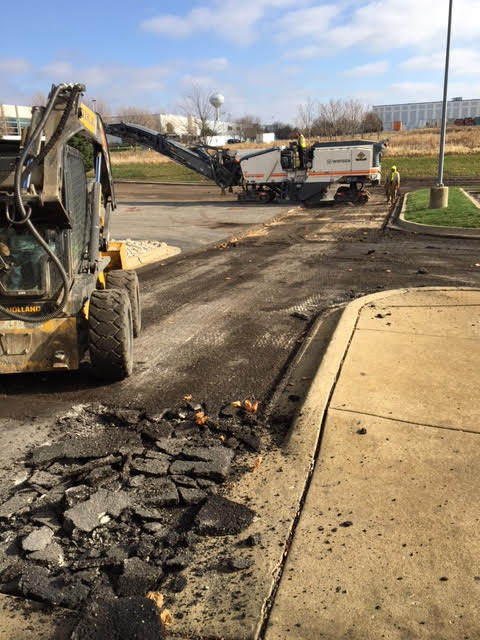
Milling machines are powerful pieces of equipment that can grind away asphalt paving very precisely and very quickly. Although milling machines have multiple uses, you will find them used frequently for edge milling during the installation of an asphalt overlay. Edge milling is essentially a method of ensuring that existing features remain at their proper elevation.

Asphalt Overlays: What Is Edge Milling?

Why Should a Paving Company Care About the Elevation of Existing Features?

Your parking lot contains more than just an expanse of pavement. There are curbs, grates, gutters, connecting drives, and other features. If you have ever noticed a manhole cover or other feature that seems unusually recessed into the pavement, it is highly likely that an overlay was installed without edge milling. Overlays typically add between two and three inches of thickness to the pavement, which is roughly half of the height of most curbs. Imagine how jarring it can be when a vehicle drives across a sunken grate or an uneven transition. Next, consider how the drainage of your pavement would be impacted by reducing the ability of your gutters and curbs to direct away the water. There is one additional reason to insist that your paving company perform edge milling when you have an overlay installed, and it is an important one: money. You could find yourself embroiled in a lawsuit if someone suffers an injury from tripping over a sunken drain grate, or you could be fined for your failure to comply with accessibility requirements for failing to ensure that the height of your curb ramp or pavement transition exceeds regulatory specifications.

Trust Black Hawk Paving for All Your Pavement-Related Needs

Since 1975, we have been helping customers throughout greater Chicagoland with their pavement installations, repairs, and maintenance. We have an unblemished reputation for craftsmanship, professionalism, customer service, and integrity. Our services include asphalt resurfacing and paving, sealcoating, concrete installation, site grading, parking lot striping, concrete repair, and hot crack sealing. We serve national clients as well as local companies. To request a free quote, simply fill out the online form. If you would rather call us, we can be reached at 773-378-2390, 708-479-0400, or 847-240-2560.