Preventing Paving Hazards in Distribution Centers: Problems and Fixes
 Preventing Paving Hazards in Distribution Centers: Problems and Fixes
Distribution centers support a flurry of nonstop activity, with heavy-duty transport trucks moving in and out all day, every day. Unfortunately, that activity can lead to several issues that impact both safety and operational efficiency. In this blog, we’ll highlight several common paving hazards in distribution centers and how you can address them.
How Can Proper Construction Minimize Paving Hazards in Distribution Centers?
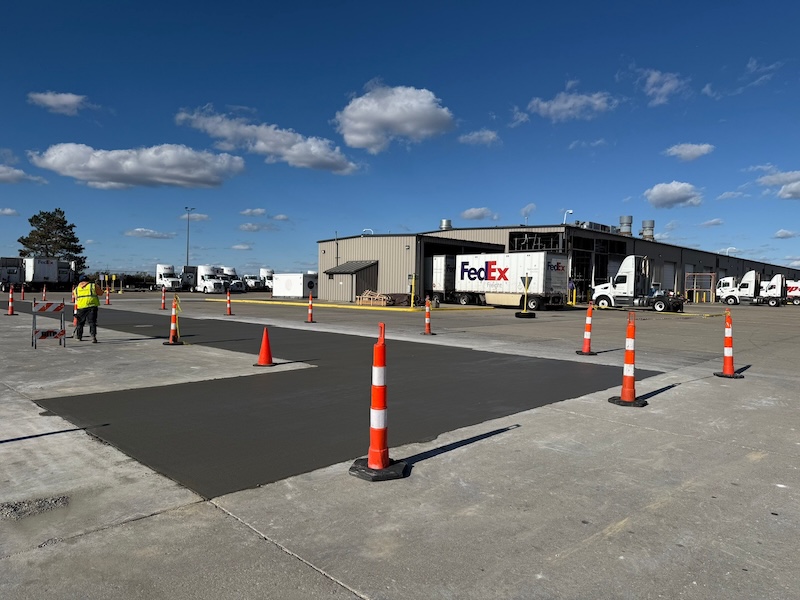
Both asphalt and concrete paving for distribution centers require precise engineering and top-quality construction. During the construction phase, work with experienced contractors who understand the complexities of large-scale industrial and commercial paving.
The best concrete and asphalt paving companies will engineer surfaces to meet your exact needs, choosing the appropriate thickness and asphalt course to support long-term reliability. They’ll also perform soil tests to build a strong foundation that can withstand for decades.
Depending on your needs, paving contractors may recommend more premium materials, such as polymer-modified asphalt, to enhance long-term performance and avoid damage.
What Can I Do to Address Cracking and Potholes on Paving for Distribution Centers?
Paving for distribution centers is susceptible to cracking. Once cracks develop, water can seep into them, eroding the foundation layers and forming potholes. There are a few ways to minimize the risks of damage.
The most impactful is regular sealcoating. Sealcoating helps prevent early oxidation, keeping asphalt paving pliable and damage-resistant. Beyond sealcoating, you must be vigilant about handling repairs. Fill and seal cracks once or twice a year, and patch potholes as soon as they occur. Prompt action will prevent damage from spreading.
For surfaces already prone to cracking and damage, contractors may recommend services like resurfacing. Great for distribution center parking lots and drives, resurfacing replaces deteriorated surface material with fresh asphalt. It adds strength and years of longevity, all without the cost or downtime of reconstruction.
What Causes Rutting on Asphalt Paving?
Rutting occurs when repeated traffic from heavy vehicles and equipment creates grooves in asphalt paving. It’s often a byproduct of poor weight management or a weakened subbase.
Weight management can help prevent rutting. Experts recommend monitoring weight limits to ensure that vehicles don’t use surfaces purpose-engineered for added strength and stability.
In high-traffic areas prone to rutting, contractors may recommend milling or full-depth reclamation. They may also advise rebuilding with stronger asphalt mixes. Polymer-modified asphalt or stone matrix asphalt are suitable choices.
How Can I Correct Edge Cracking and Similar Paving Hazards in Distribution Centers?
Edge cracking is common in distribution centers. Pavement edging often lacks the support needed to withstand heavy vehicles, leading to cracking and crumbling. The go-to solutions for this problem include rebuilding edges with considerably thicker asphalt paving or adding concrete curbing.
Surrounding asphalt surfaces with curbs and concrete paving for distribution centers can provide additional strength. Curbing can also redirect water, preventing it from seeping beneath asphalt edges.
Are There Any Solutions for Standing Water in Distribution Center Parking Lots?
Standing water is not a problem you should ignore. Pooling water can lead to rapid deterioration, creating a litany of safety issues on distribution center parking lots, drives, and docks.
The best solution for distribution centers is to improve drainage. Adding new infrastructure, including catch basins and edge drains, can help collect water runoff. Surfaces with severe subsidence issues may require reconstruction and regrading.
How Do I Improve the Longevity of Striping for Distribution Centers?
Striping for distribution centers helps to keep traffic moving smoothly, ultimately boosting safety and operational efficiency. However, traditional striping has a short lifespan of only 18 to 24 months. Fast fading creates visibility issues. Furthermore, frequent striping service appointments can lead to significant downtime for distribution centers.
To improve longevity, invest in premium striping for distribution centers. Hard-wearing alternatives to water- and solvent-based paints last significantly longer. One example is thermoplastic striping for distribution centers. It can last five years or more, requiring fewer reapplications while retaining color vibrancy for longer.
Let Black Hawk Paving develop solutions for all your paving needs. We’re an experienced paving contractor offering nationwide service. Our team can manage asphalt and concrete paving for distribution centers across the country, ensuring top-quality construction, effective maintenance, and more. We can manage your entire portfolio, offering consistent care and development services that count.
Our services include new asphalt and concrete paving, large-scale milling, full-depth reclamation and soil stabilization, striping, hot crack sealing, repairs and patching, bollards, wheel stops, and more.
Let us show you why there’s no better company to trust with your paving for distribution centers. Contact Black Hawk Paving to discuss your needs and request a free, no-obligation quote. You can call us at (877) 247-1975, email info@blackhawkpaving.com, or use our online form to get in touch.